EN
EN

News
Amid the Semiconductor Industry Boom, How Does the Industrial Chiller Become a Hidden Champion ?
In semiconductor manufacturing, chip yield depends not only on lithography precision but also on the ±0.1°C stability of cooling water. The industrial chiller, as critical process cooling equipment, governs this "temperature lifeline" and is transitioning from a supporting role to a core determinant of product yield.
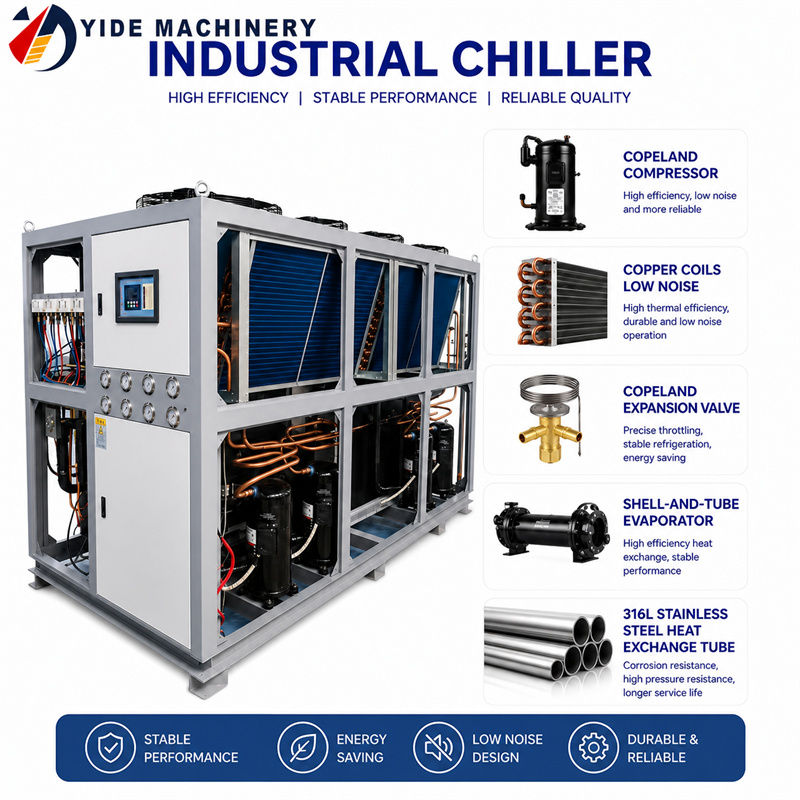
I. Why High-Precision Chillers Are Indispensable
During wafer processing, CVD, etching, ion implantation, and lithography equipment generate substantial heat. Unstable cooling directly causes process drift and yield loss.
- Etching and Ion Implantation: Temperature fluctuations cause etch rate deviations or non-uniform implantation depth, leading to wafer scrappage.
- Lithography and Exposure: Chillers must supply ±0.1°C cooling water to maintain lens and light source stability, preventing thermal expansion misalignment.
- Laser Annealing and Dicing: Water temperature affects laser wavelength and output power; precision chillers ensure consistent beam quality.
II. Core Applications Across Semiconductor Manufacturing
Industrial chillers cover the entire manufacturing workflow, from front-end fabrication to back-end packaging and testing.
Front-end equipment:
- Etching systems
- Ion plating systems
- Single-wafer processors
- CVD/PVD equipment
Back-end equipment:
- Exposure tools
- Developer temperature management
- Probe stations and testers
- Packaging line cooling
Chillers are also critical in LED, MEMS, and power device production.
III. Key Selection Criteria
Semiconductor manufacturing demands extreme reliability, precision, and cleanliness. Priority parameters include:
Temperature Control Precision: ±0.1°C to ±0.5°C required; standard ±1°C units are inadequate.
Cooling Capacity: Calculate based on thermal load with a 10%-20% excess margin to prevent compressor overload.
Material and Water Quality: Corrosion-resistant stainless steel piping with automatic fluid replenishment and water quality monitoring to prevent wafer contamination.
Communication Protocols: Support for ModBus-485, Ethernet/IP for MES integration and remote monitoring.
Cleanliness and Noise: Cleanroom-compliant surfaces and controlled noise levels.
IV. Chiller Type Comparison
| Type | Characteristics | Applications |
| Air-Cooled | Flexible, no cooling tower; ambient-temperature dependent | Small/medium systems, labs |
| Water-Cooled | High efficiency, stable, continuous-duty capable | Large production lines |
| Precision Constant-Temp | ±0.1°C accuracy | Lithography, lasers, inspection |
| Dual-Temperature | Two cooling water temperatures | Multi-zone process needs |
V. Industry Trends
As process nodes shrink, temperature control requirements grow stricter. Domestic high-precision chillers are entering a critical import-replacement window.
On energy, cooling systems account for a major share of fab energy use. Variable-frequency drives and free-cooling technologies are gaining traction.
On intelligence, chillers with predictive maintenance, AI optimization, and cloud-based O&M are becoming standard for new fab lines.
VI. Conclusion
Though chillers do not directly participate in pattern transfer or material modification, they silently safeguard process stability and yield through constant temperature control. Driven by semiconductor industry growth, this equipment segment is poised for expansion. Selecting the right chiller is a long-term investment in yield and operational cost.