EN
EN

News
How to Select the Right Water Pump for an Industrial Chiller
The water pump is a key component of an industrial chiller system.
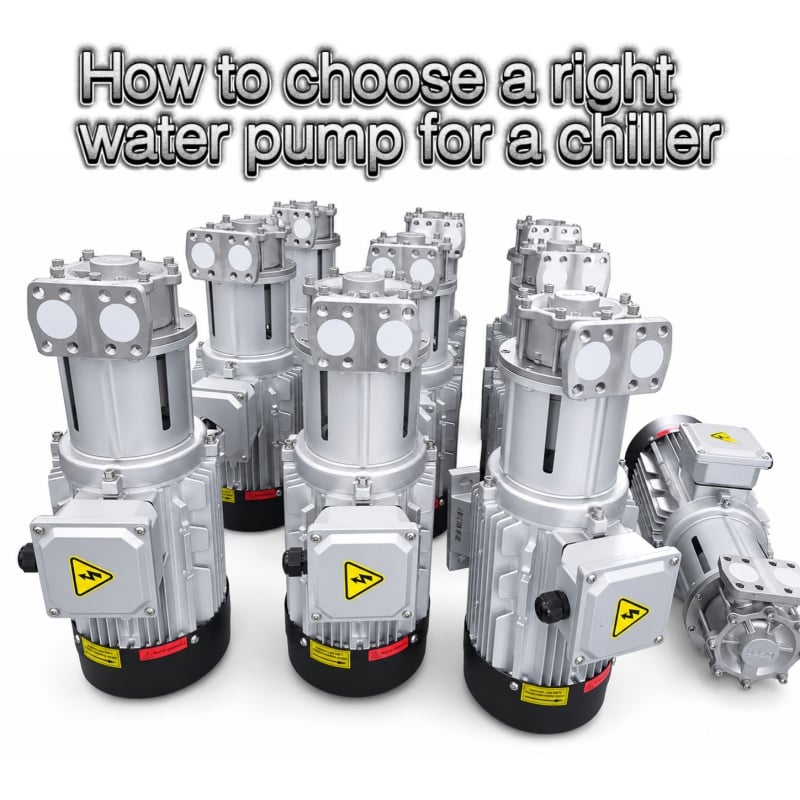
It circulates chilled water between the chiller and the process equipment, ensuring sufficient flow and stable heat transfer. Choosing the right Water Pump is not simply about selecting a larger motor. Three parameters must be considered together: Pump Flow Rate, Pump Head, and Pump Power.
1. What Does Pump Flow Rate Mean?
The pump flow rate indicates how much water the pump can circulate over a specified period. Common units include:
• m3/h — cubic meters per hour
• L/min — liters per minute
• GPM — gallons per minute
The required flow depends mainly on the chiller's cooling capacity and the temperature difference between supply and return water.
In general:
Higher cooling capacity or smaller temperature difference → higher required water flow.
However, the pump's actual flow also depends on the piping system and its resistance. Therefore, the rated maximum flow of a pump does not necessarily equal its actual operating flow.
2. What Does Pump Head Mean?
Pump head represents the energy or pressure that the pump provides to overcome resistance in the water circulation system.
It is normally expressed in meters of water column (mH₂O).
Pump head needs to overcome factors such as:
• Pipe friction
• Elbows and valves
• Filters
• Heat exchangers
• Process equipment
• Elevation differences where applicable
For a closed-loop industrial chiller system, the total building height should not simply be added to the pump head. The main consideration is usually the total pressure loss of the circulation loop. For example, a long pipeline with many valves and heat exchangers may require a higher-head pump even if the required water flow is relatively low.
3. What Does Pump Power Mean?
Pump power is the motor power required to deliver the required flow at the required head.
It is usually specified in kW or HP.
The relationship can be simplified as:
Pump Power = Flow Rate × Pump Head ÷ Efficiency
This means that when either flow or head increases, the required pump power generally increases . Therefore, pump power should not be used as the starting point for pump selection.
The correct selection sequence is:
Required Flow → Required Head → Pump Model → Motor Power
For example, two 5 HP pumps may have completely different flow and head performance.
Therefore, 5 HP does not mean a fixed pump capacity.
4. Flow Rate, Head and Power Work Together
A professional Industrial Chiller Water Pump Selection should be based on the pump's operating point.
A pump performance curve shows the relationship between flow and head.
Generally:
Higher flow → Lower available head
Higher head → Lower available flow
The ideal pump should provide the required flow at the required head while operating within an efficient and reliable range.
An oversized pump may cause:
• Excessive energy consumption
• Excessive pressure
• Higher noise and vibration An undersized pump may cause:
• Insufficient water flow
• Reduced heat-transfer efficiency
• Unstable process temperature
• Low-flow protection alarms
Therefore, bigger is not always better. The pump should be correctly matched to the actual hydraulic system.
5. Common Water Pumps for Industrial Chillers
For industrial chiller systems, two common pump configurations are widely used.
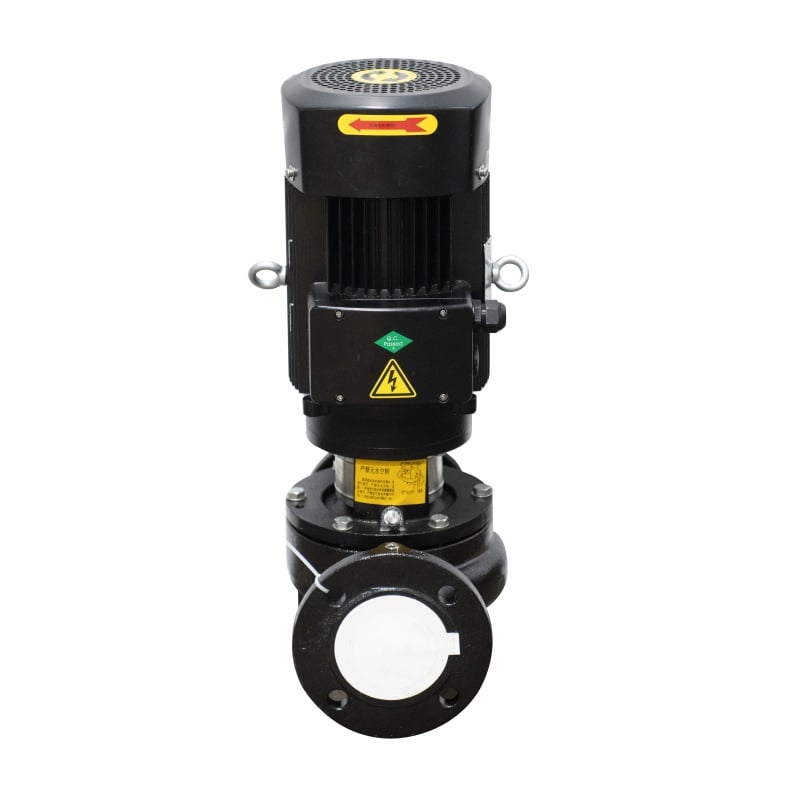
Vertical Inline Water Pump
Vertical inline pumps are commonly used for large industrial chillers and high-capacity cooling systems.
Advantages include:
• Compact installation
• Space saving
• Suitable for larger water flow requirements
• Convenient integration into large chilled-water systems
They are often selected for large-capacity central cooling systems, industrial plants and applications requiring higher circulation flow.
Stainless Steel Horizontal Centrifugal Pump
Stainless steel horizontal centrifugal pumps are commonly used for small and medium-sized industrial chillers.
Advantages include:
• Simple and reliable construction
• Good corrosion resistance
• Easy maintenance
• Suitable for general industrial water circulation
They are commonly used for injection molding, extrusion, laser cooling, electronics manufacturing and other process cooling applications.
The final pump configuration should always be determined according to the required flow, head, fluid and installation conditions.
6. How to Select a Water Pump for Different Applications?
Different industrial applications have different hydraulic requirements.
Injection Molding
The priority is stable water circulation and temperature control for molds and process equipment. A suitable pump should provide stable flow with sufficient head to overcome the resistance of the mold circuit and connecting pipes.
Extrusion
Extrusion systems may have multiple cooling zones, long pipelines and several valves or heat exchangers.
A pump with sufficient head is therefore important to maintain the required flow throughout the entire system.
Laser Cooling
Laser equipment usually requires stable flow and pressure.
The pump should be selected according to the laser manufacturer's specified flow and pressure requirements, avoiding excessive pressure that could affect sensitive components.
Chemical Industry
Pump selection must consider the fluid's:
• Chemical composition
• Concentration
• Temperature
• Viscosity
• Corrosiveness
For corrosive fluids, stainless steel or other suitable materials may be required.
Food & Beverage
For food, beverage or potable-water applications, the pump material, sealing system and hygiene requirements must be considered. If glycol is used as the secondary coolant, its concentration and viscosity should also be included in the pump calculation.
7. What Information Is Needed for Pump Selection?
To select the right Pump for a Chiller , the following information should be confirmed:
1. Cooling capacity
2. Supply and return water temperature
3. Required water flow
4. Pipe length and diameter
5. Valves, filters and fittings
6. Heat exchanger or equipment pressure drop
7. Circulating fluid and concentration
8. Installation conditions
With these parameters, the required pump operating point can be determined accurately.
Conclusion
A water pump is more than just a motor attached to a chiller. It is responsible for delivering the required chilled-water flow through the entire cooling system.
The three key parameters are:
Flow Rate — How much water needs to circulate?
Pump Head — How much resistance must the pump overcome?
Power — How much motor power is required?
The best Industrial Chiller Water Pump Selection is not the pump with the highest flow, highest head or largest motor. It is the pump that provides the required flow at the required head , while maintaining reliable and efficient operation.
If you are unsure which Water Pump is suitable for your industrial chiller, provide your cooling capacity, water temperature, flow requirement and piping conditions. A professional chiller manufacturer can then select the appropriate pump according to the actual application.