EN
EN

News
Why Bigger Isn't Always Worse: A Korean Client’s Question On Oil Tank Size And Our Professional Answer
In international trade—especially with industrial equipment like mold temperature controllers — clients often come with very specific technical requirements. Recently, we received an inquiry from a South Korean client: a 12kW oil-type temperature control unit, heating up to 100°C, with a flow rate requirement of 60L/min.
On the surface, this seemed like a standard request. But when our sales team quoted our standard 12kW configuration (with a 32-liter oil tank), the client asked a very reasonable question:
“Why do I need a 32L tank? My process only requires 10L. Can you make it smaller?”
This seemed like a simple discussion about “tank size,” but in fact, it touches on the core safety logic of mold temperature controller design.
The Client’s Confusion: Isn’t 10L enough?
The client believed that with only 12kW of heating power and a target temperature of 100°C, 10 liters of thermal oil should be “just enough.” Intuitively, a smaller tank saves space and reduces initial oil cost. This is understandable—but the design logic of a temperature controller is different.
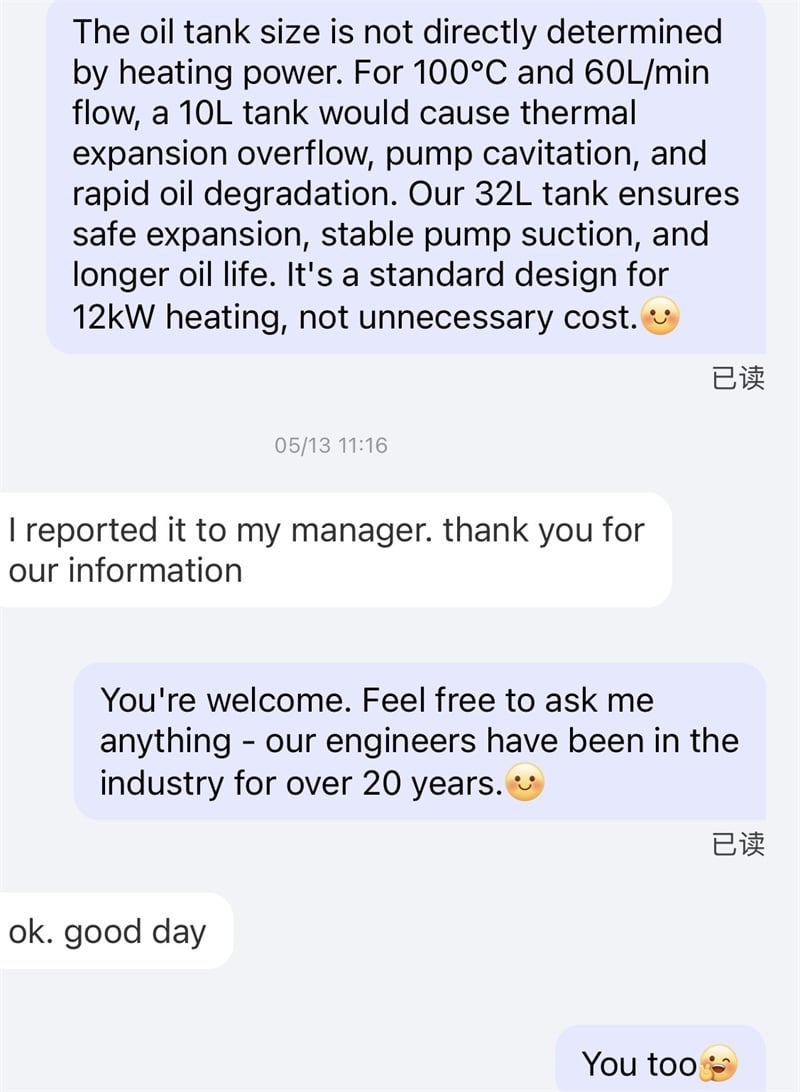
Our Engineering Team Provided Three Professional Explanations:
1. The oil tank is primarily for expansion and venting—not just storage.
Thermal oil expands significantly when heated to 100°C (about 3–4% by volume). With a 10L tank, the expanded oil would have nowhere to go and would spill out through the breather port, causing waste, contamination, and a potential fire hazard. A 32L tank provides enough expansion space to ensure safe operation at all temperatures.
2. The required flow rate of 60L/min dictates a larger tank.
Many clients don’t realize that a 60L/min flow rate means a large total oil volume in the circulating system. A standard 12kW mold temperature controller using a regular oil pump typically delivers only 20L/min. To meet the client’s 60L/min requirement, our engineering team specifically selected the Lezhiyuan magnetic drive pump, which can stably deliver 60L/ min. However, this pump requires sufficient oil in the tank to avoid cavitation. If the tank is too small, the pump will suck air, causing cavitation damage.
3. A small tank dramatically shortens oil life, increasing long-term costs.
At 60L/min, a 10L tank means the oil circulates 6 times per minute. This high-frequency shearing and oxidation will degrade the oil within months, leading to coking and sludge. A 32L tank, while requiring more initial oil, extends oil life to 1–2 years. Considering downtime and oil change costs, the larger tank is actually more economical and trouble-free.
The Result: Professionalism Wins the Order
After our engineering team patiently and thoroughly explained these technical principles, the Korean client not only dropped his concerns about the tank size but also highly appreciated our team’s expertise and service attitude.
He confirmed the order and said:
“Your engineers not only know ‘how’ to build it, but also ‘why’ it should be this way. That gives me full confidence.”
Conclusion: Expertise is the Bridge, Service is the Foundation
This case shows that in international trade, price competition alone leads nowhere. When a client raises a seemingly “unreasonable” request, that is exactly the best moment to demonstrate your professional value.
We always insist on one principle: Never blindly cater to surface-level demands. Instead, use technical expertise to solve the client’s real underlying problems. That is the true foundation of long-term cooperation.